


 PLATFORM UPDATE:


Engineering internal electric fields in photoelectrochemical systems for enhanced hydrogen evolution: mechanisms, characterization and design strategies
 *a
and
*a
and
Abstract
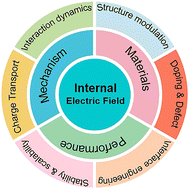
Photoelectrocatalytic (PEC) hydrogen production represents a pivotal technology for sustainable energy conversion, yet its efficiency is fundamentally limited by rapid charge recombination and sluggish reaction kinetics. This review highlights internal electric field (IEF) engineering as an innovative strategy to overcome these challenges by rationally designing catalysts at the nanoscale. We systematically discussed how tailored IEFs construction via heterojunctions, doping, surface modification, and strain engineering can dramatically enhance charge separation, transport, and surface redox kinetics in photoelectrocatalysts. By elucidating the underlying mechanisms (e.g., band bending, dipole effects, and interfacial screening), we summarized universal principles for IEF manipulation across diverse materials, including metal oxides, chalcogenides, and 2D heterostructures. Furthermore, we critically evaluate performance breakthroughs in solar-to-hydrogen conversion enabled by IEF optimization. Challenges such as field stability under operational conditions and scalability are addressed, alongside emerging opportunities in machine learning aided design. This work not only provides a guide for next-generation photoelectrocatalysts but also extends IEF strategies to broader energy applications, underscoring their transformative potential in achieving carbon neutrality.
Keywords: Internal electric field; Hydrogen evolution reaction; Heterojunction; Surface modification.
- This article is part of the themed collection: Virtual Collection – Photocatalysis
 Please wait while we load your content...


