


 PLATFORM UPDATE:


Towards safe and sustainable ionic liquids: a critical outlook on industrial and pharmaceutical integration
 a
and
Filipa A.
Vicente
*a
a
and
Filipa A.
Vicente
*a
Abstract
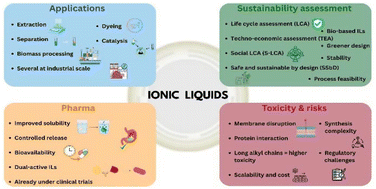
Ionic liquids (ILs) have emerged over the past three decades as highly versatile and tunable solvents whose physicochemical properties can be precisely adjusted by selecting appropriate combinations of cations and anions. In pharmaceuticals, ILs serve as solvents, excipients, and active pharmaceutical ingredients (API-ILs), addressing challenges such as poor solubility, limited bioavailability, and polymorphism. Despite rapid scientific progress, the transition of ILs from laboratory research to industrial application remains slow. Significant knowledge gaps persist in toxicity, biocompatibility, biodegradability, scalability, and long-term safety, while life-cycle assessment (LCA), techno-economic analysis (TEA), and social LCA remain limited. These gaps are further exacerbated by the structural diversity of ILs, which hinders standardised testing and predictive modelling. Addressing these challenges requires early integration of Safe and Sustainable by Design (SSbD) principles, improved computational and screening tools, and the development of protocols tailored to IL diversity. Incorporating green chemistry and circular economy approaches can streamline the identification of safer and more sustainable ILs while reducing experimental and economic burdens. This review therefore brings together environmental, economic, social, and industrial considerations, including LCA, TEA, toxicity, scalability, and current pharmaceutical applications, to provide a unified perspective on the opportunities and barriers associated with IL development. By consolidating these aspects, it aims to guide more responsible, efficient, and sustainable implementation of ILs, with relevance to API-ILs and their potential future in the pharmaceutical industry.
- This article is part of the themed collection: 2026 Green Chemistry Reviews
 Please wait while we load your content...


