


 PLATFORM UPDATE:


Active lignin stabilization in lignocellulosic biomass fractionation: mechanisms and advancements
 *a
Chunlin
Xu
*a
*a
Chunlin
Xu
*a
Abstract
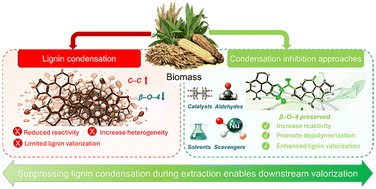
Lignin is one of the most abundant biopolymers on Earth, holding significant potential for the production of bio-based chemicals, fuels, and materials. However, its complex and heterogeneous structure poses challenges for efficient valorization. Active lignin stabilization fractionation offers a way to overcome these challenges, focusing on the selective depolymerization and stabilization and/or even functionalization of lignin during biomass processing. Unlike conventional fractionation methods, this active lignin stabilization fractionation attempts to prevent condensation of the lignin, yielding high-value aromatic compounds for further applications. This review highlights green advances in the field, including the use of deep eutectic solvents and ionic liquids, alongside innovative stabilization techniques, carbocation scavengers, and reductive catalytic fractionation. By integrating these approaches into sustainable biorefineries, this work provides a roadmap for advancing lignin valorization and contributing to the broader goals of green chemistry.
- This article is part of the themed collection: 2026 Green Chemistry Reviews
 Please wait while we load your content...


