


 PLATFORM UPDATE:

Establishing parameters for resonant acoustic mixing (RAM) chemistry using Buchwald–Hartwig amination as a model
 a
Cameron B.
Lennox,
ab
Mohammad S.
Askari,
a
Stefan G.
Koenig,
*c
Karthik
Nagapudi
*c
and
Tomislav
Friščić
*a
a
Cameron B.
Lennox,
ab
Mohammad S.
Askari,
a
Stefan G.
Koenig,
*c
Karthik
Nagapudi
*c
and
Tomislav
Friščić
*a
Abstract
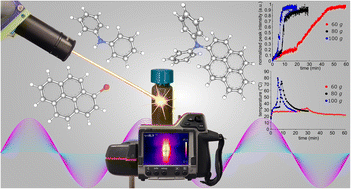
While Resonant Acoustic Mixing (RAM) has been proposed as a scalable methodology for environmentally-friendly synthesis, notably media-free mechanochemical synthesis, the underlying reaction environment and the parameters that govern reaction control, optimization, and scale-up remain poorly understood. Using the Buchwald–Hartwig amination as a model system, this study provides insight into the RAM reaction environment and establishes design parameters through a combination of systematic screening and multimodal, real-time in situ monitoring of reaction progress, temperature evolution, and the transformations of crystalline and non-crystalline bulk phases. The simultaneous application of benchtop infrared thermography, and fingerprint- and terahertz-region Raman (THz-Raman) spectroscopy enables the direct correlation of reactivity, thermal behaviour, and phase evolution. Specifically, this work identifies the filling ratio (φ), acceleration, and the amount of liquid additive (η) as critical parameters to design tunable and scalable (at least 100 mmol) reactivity under RAM conditions, in short timeframes. Real-time monitoring reveals that rapid Buchwald–Hartwig reactivity is associated with autogenous heating, and that φ and acceleration serve as parameters that can be used to control reaction kinetics and temperature evolution. By identifying experimentally accessible reaction control parameters and presenting a benchtop-only design for the simultaneous monitoring of temperature, reaction progress and evolution of transient bulk phases, this work provides a foundation for the rational design, control, and safety of chemistry under RAM conditions.
 Please wait while we load your content...


