


 PLATFORM UPDATE:


Valorization of consolidated bioprocessing residues for bioplastics
 ad
Mohammad
Aghajohari,
adf
Bruno C.
Klein,
b
Rebecca J.
Hanes,
b
Kush G.
Patel,
a
Jason J.
Locklin,
ae
Sergiy
Minko
a
and
Breeanna R.
Urbanowicz
*adef
ad
Mohammad
Aghajohari,
adf
Bruno C.
Klein,
b
Rebecca J.
Hanes,
b
Kush G.
Patel,
a
Jason J.
Locklin,
ae
Sergiy
Minko
a
and
Breeanna R.
Urbanowicz
*adef
Abstract
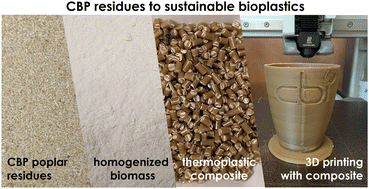
This study demonstrates an organic solvent-free processing strategy to valorize consolidated bioprocessing (CBP) residues, from switchgrass and poplar biomass, into functional poly(butylene succinate) (PBS)-based biocomposites using high-shear homogenization (HSH). HSH transformed the switchgrass and poplar CBP residues (CBP-R) into fine, uniformly distributed particles and microfibers. The composites of PBS with homogenized switchgrass residues (H-CBP-R-SG) or homogenized poplar residues (H-CBP-R-P) at a 70/30 weight ratio exhibited improved processability and mechanical integrity, with the Young's modulus for the PBS/H-CBP-R-SG and PBS/H-CBP-R-P nearly doubling to 0.66 ± 0.07 GPa and 0.65 ± 0.04 GPa, respectively, compared to neat PBS (0.36 ± 0.02 GPa). Dynamic Mechanical Analysis (DMA) reveals a significant suppression of the tan δ peak magnitude, indicating that HSH-mediated physical activation facilitates stress transfer in composites typical of covalent chemical grafting systems. While the transition to a stiffness-dominated profile reduces ductility, the resulting composites exhibit the dimensional stability and resistance to thermal warping required for high-fidelity FDM 3D printing and injection molding. Beyond material performance, comprehensive techno-economic analysis (TEA) and life cycle assessment (LCA) confirmed that diverting CBP residues into composite products can improve the economic viability of the biorefinery without substantially increasing biorefinery global warming potential (GWP). At a 30 wt% blend ratio, incorporating residuals into PBS yielded a minimum selling price for the composite of $4.07 per kg compared to the conventional bioplastic price of $5.00 per kg. This approach aligns with circular bioeconomy principles by converting waste streams into value-added products. Furthermore, this innovative strategy addresses key challenges in bioplastic development, including cost, compatibility, and performance, while simultaneously advancing waste minimization strategies for sustainable manufacturing systems.
- This article is part of the themed collection: Advanced Eco-Manufacturing and Sustainable Bioproducts with Lignocellulosic Biomass
 Please wait while we load your content...


