


 PLATFORM UPDATE:


Towards scalable production of bound extracellular polymeric substances (B-EPS): autoclave hydrothermal extraction coupled with solvent-free ultrafiltration
 abc
Filipa
Rodrigues,
ab
Marisa
Faria,
*ab
Juan L.
Gómez Pinchetti,
d
Artur
Ferreira
c
and
Nereida
Cordeiro
*ab
abc
Filipa
Rodrigues,
ab
Marisa
Faria,
*ab
Juan L.
Gómez Pinchetti,
d
Artur
Ferreira
c
and
Nereida
Cordeiro
*ab
Abstract
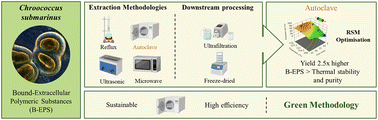
Bound extracellular polymeric substances (B-EPS) are extracellular polysaccharides tightly attached to cyanobacterial and microalgal cell surfaces, representing a high-value class of biopolymers with industrial potential. Selective extraction is technically challenging due to strong adhesion to the cell wall and potential co-extraction of soluble EPS. Conventional methods can be chemically aggressive and may involve high energy and/or solvent inputs, making solvent-free extraction routes desirable. In this work, four hydrothermal extraction techniques (reflux, autoclave, ultrasonic bath, and microwave) were evaluated for their ability to recover B-EPS from the marine cyanobacterium Chroococcus submarinus (BEA 1200B), followed by a harmonised ultrafiltration step. Each method was assessed for extraction efficiency and its impact on bulk descriptors (inorganic carry-over, ATR-FTIR, zeta potential, and thermal profiles) and morphology. Among the methods tested, autoclave extraction demonstrated the highest performance, yielding up to 2.5 times more B-EPS than the other methods and showing reduced inorganic carry-over after purification. Across all methods, the purified B-EPS fractions exhibited broadly comparable bulk profiles under the applied analytics. Response Surface Methodology (RSM) applied to the autoclave system identified temperature and extraction time as key variables; optimal conditions (biomass-to-solvent ratio 1 : 20 (w/v), 130 °C, 16 min) enabled >90% recovery. Coupling autoclave extraction with solvent-free ultrafiltration avoids solvent precipitation and the use of hazardous reagents, enabling desalting and removal of low-molecular-weight components. Using a photosynthetic marine strain supports seawater cultivation and biogenic CO2 uptake, aligning the workflow with carbon-mitigation goals.
 Please wait while we load your content...


