


 PLATFORM UPDATE:

Enhancing multi-enzymatic CO2 conversion via reactor engineering: effects of mass transfer on sustainable and green metrics

Abstract
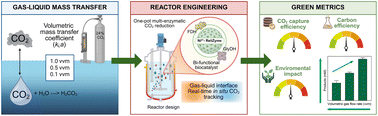
The global energy transition toward decarbonization requires highly efficient Carbon Capture and Utilization (CCU) technologies that combine economic feasibility, operational stability and environmental sustainability. A key factor for successful CCU is efficient CO2 gas–liquid transfer, which can be optimized through tailored reactor designs to maximize yields and utilization. Technological advances such as CO2-specific sensors have enabled accurate monitoring of CO2 mass balance enhancing the efficiency of its conversion. This work addresses an in-depth analysis of CO2 mass transfer in a stirred-tank reactor, focusing on the impact of volumetric gas flow rate on gas–liquid transfer during the multi-enzymatic conversion of CO2 into high-value compounds using a co-immobilized biocatalyst of formate dehydrogenase and glycerol dehydrogenase enzymes. The volumetric mass transfer coefficient (kLa) was determined at different gas flow rates (1, 0.5 and 0.1 vvm) from a 24% CO2 gas mixture, with the reaction carried out at 0.1 vvm achieving an outstanding formate production of 66.1 ± 1.4 mM (3 g L−1), due to near-neutral pH conditions that improved the reaction conditions and enhanced biocatalyst stability by at least 1.8-fold compared with high gas flow rate (1.0 vvm). Furthermore, a remarkable CO2 capture efficiency of 93.3 ± 2.1% was achieved at 0.1 vvm, along with a high selectivity toward formate and glycerol carbonate, reflecting a complete CO2 conversion into target products. Finally, the environmental impact of the reaction at 0.1 vvm showed a lower contribution to climate change, reaching 13.2 kg CO2 eq. per kg products. These results underscore enzymatic CO2 reduction as an effective and sustainable approach for the development of bio-based industrial processes with a markedly reduced environmental footprint.
 Please wait while we load your content...


