


 PLATFORM UPDATE:


Upcycling silicon from End-of-Life photovoltaic panels to a heterogeneous catalyst for the Mizoroki–Heck cross-coupling

Abstract
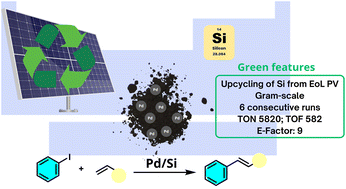
Beyond the global shift toward solar-derived renewable energy sources, a significant concern has also emerged. With an average lifetime of 25–30 years, global photovoltaic (PV) waste is expected to account for 8 million tons of total installed by 2030. Consequently, the challenge of managing the enormous volume of End-of-Life (EoL) PV modules is emerging as a significant environmental issue for the coming decades. High-purity, energy-intensive silicon wafers account for about 3–4% of a photovoltaic module's total weight and represent a significant fraction of its total cost. Consequently, the development of effective strategies to upcycle silicon scraps from discarded solar panels is urgently needed. Herein, we propose a circularly driven waste-to-wealth strategy for a novel application for the globally growing EoL solar panel waste streams, using Si as a heterogeneous support for Pd nanoparticle-based catalytic systems. We have achieved excellent performance in the Mizoroki–Heck reaction, comparable to, or even better than, that of well-established Pd-based heterogeneous catalysts, in terms of catalytic activity, minimal palladium leaching, and excellent recyclability. 20 different products have been prepared, including an intermediate for the synthesis of an Lp-PLA2 inhibitor, methyl (E)-ferulate, and a rilpivirine intermediate.
 Please wait while we load your content...


