Synthesis of Thermo-Shear-Responsive Dynamic Covalent Networks based on Humins and the Diels-Alder Reaction

Abstract

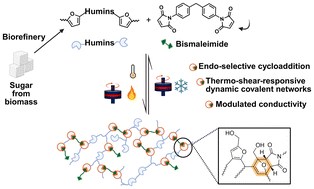
Humins are unavoidable by-products of biorefineries that convert sugars into functional platform chemicals. In this work, we present a strategy for utilizing them as reagents in Diels-Alder (DA) reactions. By leveraging their furan-rich structure, we demonstrate their principal reactivity with conventional dienophiles such as bismaleimides, which enables the formation of stable, reprocessable dynamic covalent networks. Notably, occurring cycloadditions are enantioselective yielding exclusively endo-adducts. Furthermore, these DA reactions display an unusual, reversed character, with the forward reaction proceeding at high temperature and the retro-DA reaction occurring at low temperature. The obtained materials exhibit tunable thermal and mechanical properties, self-healing behavior, and the potential for modulating electrical conductivity. Taken together, our findings establish a practical pathway for valorizing biorefinery side streams through the conversion of humins into high-performance materials.

Supplementary files

Transparent peer review

To support increased transparency, we offer authors the option to publish the peer review history alongside their article.

View this article’s peer review history

Article information

Article type
Paper
Submitted
05 Jan 2026
Accepted
26 Mar 2026
First published
30 Mar 2026
This article is Open Access
Creative Commons BY-NC license

Green Chem., 2026, Accepted Manuscript

Synthesis of Thermo-Shear-Responsive Dynamic Covalent Networks based on Humins and the Diels-Alder Reaction

D. Kandemir, M. Mekala, R. Cardinaels, P. Van Puyvelde and A. Ginzburg, Green Chem., 2026, Accepted Manuscript , DOI: 10.1039/D6GC00070C

This article is licensed under a Creative Commons Attribution-NonCommercial 3.0 Unported Licence. You can use material from this article in other publications, without requesting further permission from the RSC, provided that the correct acknowledgement is given and it is not used for commercial purposes.

To request permission to reproduce material from this article in a commercial publication, please go to the Copyright Clearance Center request page.

If you are an author contributing to an RSC publication, you do not need to request permission provided correct acknowledgement is given.

If you are the author of this article, you do not need to request permission to reproduce figures and diagrams provided correct acknowledgement is given. If you want to reproduce the whole article in a third-party commercial publication (excluding your thesis/dissertation for which permission is not required) please go to the Copyright Clearance Center request page.

Read more about how to correctly acknowledge RSC content.

Social activity

Spotlight

Advertisements