


 PLATFORM UPDATE:


Citric acid: a powerful biomass-derived host doped with diverse guests for green room-temperature phosphorescence materials
 *a
*a
Abstract
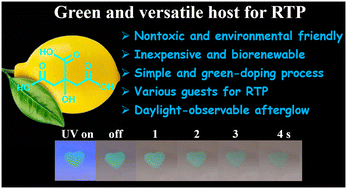
Guest–host doping is a strongly preferred strategy for organic room-temperature phosphorescence (RTP). Nontoxic, low-cost and versatile hosts are highly desirable for achieving green RTP materials and ultimate practical applications. Herein, edible biomass-derived citric acid (CA) is developed as a novel, green and biorenewable host to activate the persistent RTP of a wide range of aromatic guests, including simple arene, boronic acid, carboxylic acid, aldehyde, phenol, alcohol, halohydrocarbon and alkaloid. In total, 20 representative RTP samples are fabricated by a simple and green process. They show a colorful afterglow, part of which could be directly observed under natural light. The RTP lifetimes range widely from 0.092 to 2.15 s. Experimental and theoretical results reveal that the CA molecules could not only provide a rigid matrix by virtue of the large number of hydrogen bonds but also considerably promote the intersystem crossing of the guest molecule. These RTP materials show promising applications in anticounterfeiting, three-mode latent fingerprint visualization, rewritable luminescent paper preparation and stimuli-responsive sensing. In this study, we develop a powerful biomass-derived host for achieving green and sustainable RTP materials. Based on its excellent versatility, CA could be a promising alternative to traditional fossil fuel-derived hosts.
 Please wait while we load your content...


