


 PLATFORM UPDATE:


Cu-based catalysts for efficient electrochemical nitrate reduction to ammonia
 *bcd
Zhi-Jun
Zuo,
*a
*bcd
Zhi-Jun
Zuo,
*a
Abstract
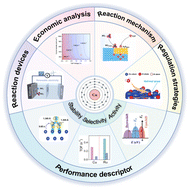
The dual demands of sustainable wastewater remediation and green ammonia synthesis have driven the development of electrocatalytic nitrate reduction (NO3−RR) as a promising environmentally benign alternative to conventional processes. Copper (Cu)-based catalysts, with tunable valence states, strong nitrate adsorption, and low cost, are among the most promising candidates. Although some reviews have summarized advances in this field, most remain fragmented, with limited integration of fundamental mechanisms, material design strategies, and system-level engineering. To address this gap, this review offers a comprehensive overview of Cu-based NO3−RR from a multi-scale perspective encompassing the mechanism–material–practical applications. We highlight strategies to regulate catalytic performance and promote rational structure–function coupling design. A summary of the key descriptors for activity, selectivity, and stability provides the framework for probing the essential catalytic mechanisms via combined experimental and theoretical insights. Furthermore, we extend the discussion beyond materials to device-level configurations, techno-economic feasibility, and scale-up challenges, emphasizing the energy–environment nexus and potential for circular nitrogen management. This work aims to provide not only a foundational reference for designing efficient Cu-based electrocatalysts but also a green chemistry-oriented roadmap for valorizing nitrate-containing wastewater into valuable ammonia, thereby contributing to sustainable nitrogen cycles and low-carbon chemical production.
- This article is part of the themed collection: 2026 Green Chemistry Reviews
 Please wait while we load your content...


