


 PLATFORM UPDATE:


Resonant acoustic mixing for green guanylation: thiourea trioxide as a solid cyanamide surrogate toward guanidine carbonate salts
 *a
and
*a
and
Abstract
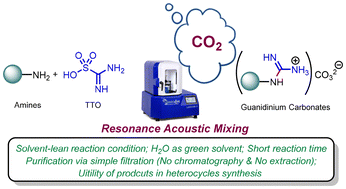
Faraday instability is a well-documented fluid-dynamic phenomenon in which nonlinear waves emerge on a liquid surface subjected to high-amplitude, high-frequency vertical vibrations. Resonance Acoustic Mixing (RAM) is an innovative technique that leverages this phenomenon to achieve intense, media-free mixing via resonance-based vertical oscillations at 58–60 Hz. Under these conditions, kinetic and potential energies are balanced, allowing the applied acceleration to be adjusted up to 100 g. In this context, we introduce a mechanochemical RAM technique for the efficient and sustainable synthesis of guanidines, utilizing thiourea trioxide (TTO) as the guanylating agent. This protocol effectively produces a wide range of alkyl- and aryl-substituted guanidine derivatives in high yields, with shorter reaction times and straightforward filtration steps that enable the direct isolation of guanidine carbonate salts. These advantages make this method highly competitive with conventional solution-based approaches, which often require toxic solvents and hazardous reagents and offer a limited substrate scope. The protocol is easily scalable to gram quantities, underscoring the industrial potential of RAM synthesis in this regard. Additionally, the resulting guanidine carbonates and picrates can be readily converted into aminopyrimidine heterocycles under solvent-free ball milling conditions.
 Please wait while we load your content...


