


 PLATFORM UPDATE:


Solvent-controlled divergent 1,2-dialkylation and 1,1,2-bromodialkylation of terminal alkynes to access difluoroalkylated cyclopentanes
Huifeng
Yue  *a
*a
*a
Abstract
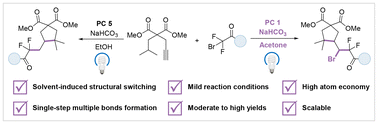
The 1,1,2-trifunctionalization of alkynes is an atom-economical strategy that enables the rapid construction of multiple C–C and C–heteroatom bonds in a single synthetic operation. Herein, we present a radical addition–translocation–cyclization cascade that achieves the 1,1,2-trifunctionalization of terminal alkynes, delivering difluoromethyl-containing polysubstituted cyclopentanes with high efficiency. Notably, simple solvent modulation enables a switchable divergence to 1,2-difunctionalized products, offering enhanced synthetic flexibility. The protocol features mild conditions, operational simplicity, and broad substrate tolerance and is well-suited for both scale-up synthesis and late-stage diversification.
 Please wait while we load your content...


