


 PLATFORM UPDATE:


Diastereoselective construction of complex spiroheterocycles via γ-C(sp3)–H functionalization of 1,1-disubstituted cyclohexanes with diverse bifunctional reagents

Abstract
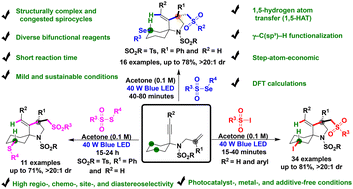
Selective γ-C(sp3)–H functionalization within radical cascade sequences for constructing spiroheterocycles remains a significant challenge in organic synthesis, particularly when targeting sterically encumbered, conformationally rigid scaffolds with high stereocontrol. Herein, we report a visible-light-driven, metal-, photocatalyst-, and additive-free radical cascade enabling highly diastereoselective (dr > 20 : 1) synthesis of densely functionalized spirocyclic-azaspiro[4.5]decane derivatives from 1,1-disubstituted cyclohexanes. Employing diverse bifunctional reagents—including sulfonyl iodides, selenosulfonates, and thiosulfonates—this cascade proceeds via regio- and chemoselective radical addition, intramolecular 5-exo–dig spirocycliza-tion, and stereodefined 1,5-hydrogen atom transfer (1,5-HAT) from an in situ-generated C(sp2) radical center, culminating in remote C–X (X = I, SePh, SPh) bond formation. This method achieves site-, regio-, chemo-, and stereocontrol under mild, sustainable conditions. Based on the obtained X-ray crystallographic data, DFT calculations on representative isomers show excellent agreement, supporting the stereochemical assignments and providing insight into the observed diastereoselectivity. The approach is green, atom-economical (100%), and operationally simple, and, based on green chemistry metrics, it is efficient and environmentally benign, featuring a low E-factor and high EcoScale score (71 on a scale of 0–100), thereby providing a practical and sustainable method for spiroheterocycle synthesis.
 Please wait while we load your content...


