


 PLATFORM UPDATE:


An iridium-mediated bimetallic nanocatalyst for simultaneous enhancement of catalytic activity and metal–support interaction towards efficient and robust hydrogen evolution
 *a
and
Dingxuan
Ma
*a
*a
and
Dingxuan
Ma
*a
Abstract
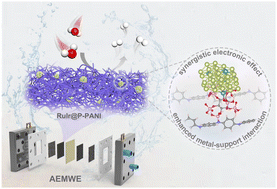
The rational design of supported bimetallic nanocatalysts with high activity and stability offers significant potential for advancing electrolytic hydrogen evolution reactions (HERs). While extensive research has primarily focused on the effects of doping a modulating metal to optimize the electronic structure of the host metal and enhance electrocatalytic performance, the potential role of the modulating metal as a unique interfacial bridging site that may influence or strengthen interactions between nanoparticles and the support has been relatively neglected. Herein, we report the development of a highly efficient electrocatalyst, RuIr@P-PANI, featuring synergistic RuIr nanoparticles self-assembled on a phytic acid-functionalized polyaniline (P-PANI) support, which exhibits outstanding catalytic performance with ultralow overpotentials across the entire pH range. Comprehensive experimental characterization combined with theoretical calculations reveals that Ir serves as a dual-functional component, which not only optimizes the electronic structure of Ru active sites to boost intrinsic catalytic activity but also enhances the coupling between metal nanoparticles and the P-PANI support through the formation of Ir–O interfacial bonds. Owing to this synergistic effect, an anion exchange membrane water electrolyzer (AEMWE) fabricated using RuIr@P-PANI exhibits stable operation at 80 °C with an outstanding industrial-level hydrogen production activity (1.69 V@1 A cm−2 and 1.85 V@2 A cm−2).
 Please wait while we load your content...


