


 PLATFORM UPDATE:


Constructing a Ca-rich protective layer on the anode for high-performance aqueous zinc-ion batteries

Abstract
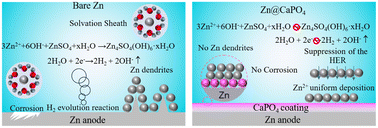
Zinc metal anodes (ZMAs) are notable among aqueous ion battery anodes for their low cost, high specific capacity and low redox potential. However, zinc anodes still encounter many challenges such as hydrogen evolution reactions (HERs), zinc dendrite growth and electrode corrosion, which can result in short circuits and pose serious safety risks. In this study, a calcium-rich (Ca10(OH)2(PO4)6) protective layer was constructed on the surface of the zinc anode by a simple coating process, which aimed to regulate the homogeneous deposition of Zn2+, reduce the nucleation potential of Zn, and suppress zinc dendrite growth. Furthermore, the porous calcium-rich layer enhanced Zn2+ migration, reduced water activity, mitigated side reactions at the electrode–electrolyte interface, and effectively prevented corrosion of the ZMA. Consequently, the Zn/Zn symmetric cell assembled based on the modified ZMA was able to cycle stably for 1180 h at 5 mA cm−2. Moreover, the capacity of the NH4V4O10 (NVO)/Zn full cell assembled based on the modified Zn anode was still 144.69 mAh g−1 after 700 cycles at 1 A g−1 current density. This work provides a straightforward and effective approach for achieving stable ZMAs.
 Please wait while we load your content...


