


 PLATFORM UPDATE:

Sustainable photoredox C(sp3)–P bond formation via nitrogen-vacancy-engineered carbon nitride

Abstract
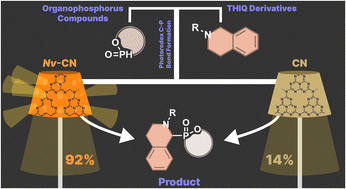
Selective construction of C(sp3)–P bonds remain a fundamental challenge in green chemistry due to the widespread use of transition-metals, peroxides, or stoichiometric oxidants in state-of-the-art methodologies. Here, we report a metal-free, selective and sustainable strategy for oxidative C(sp3)–P bond formation using nitrogen-vacancy-engineered carbon nitride (Nv-CN) photocatalysts. A series of Nv-CN were synthesized by thermal annealing of pristine CN under controlled temperatures and atmospheres, revealing a clear structure–defect–activity relationship that correlates nitrogen vacancies with their enhanced photocatalytic performance. Among them, cyanamide-based Nv-CN annealed at 650 °C under argon atmosphere, Nv-CN(C)-650Ar, demonstrated the highest photocatalytic activity in the photoredox C(sp3)–P bond formation, achieving up to 92% yield within 1 hour under blue LED irradiation at room temperature, outperforming previously reported photocatalytic systems. Structural analyses revealed that the superior performance of Nv-CN(C)-650Ar is closely linked to an optimized N-vacancy concentration and favorable material properties, including a highly disordered structure, increased –NHx functionalities, and a high density of paramagnetic defects. The photocatalyst also exhibits a porous architecture, large surface area, strong visible-light absorption, a narrowed bandgap, and suppressed charge recombination due to the mid-gap states. Mechanistic studies indicate a single-electron oxidation pathway mediated by superoxide radicals. Nv-CN(C)-650Ar demonstrates broad substrate scope, excellent stability, and reusability over five consecutive cycles. For the optimized model C–P bond formation on a 0.25 mmol scale, the E-factor was calculated to be E = 1.4 by excluding the recyclable solvents. This work not only fills a critical gap in green C(sp3)–P bond formation, but also introduces the vacancy-performance relation through mechanistic understanding of defect engineering in CN materials and offers a sustainable, metal-free photocatalytic strategy for C–H functionalization.
 Please wait while we load your content...


