


 PLATFORM UPDATE:


Bait-and-anchor strategy in dual N/Se-engineered resins for electrostatic-chelation cascade Pd(ii) recovery from extreme environments
 *a
Jianming
Pan
*a
*a
Jianming
Pan
*a
Abstract
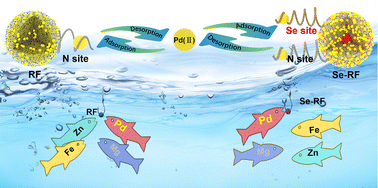
The imperative to selectively recover palladium from complex secondary sources is compounded by the significant technical challenges involved. This study introduces a heteroatom-engineered resorcinol-formaldehyde resin microsphere (Se-RF) with dual N/Se doping, which implements a “bait-and-anchor” strategy for highly efficient Pd(II) recovery from challenging environments. The Se-RF adsorbent significantly outperforms conventional RF resins, owing to its heteroatom-cooperative capture mechanism. The breakthrough lies in: (1) an ultrafast in situ doping polymerization process, facilitated by high-speed stirring, yielding uniform microspheres within 5 min under ambient conditions; (2) the dual role of ammonia as both polymerization catalyst and nitrogen precursor, creating “soft base” sites that enhance electrostatic affinity; and (3) synergistic N/Se binding, endowing the resin with a high Pd(II) uptake capacity of 447 mg g−1 at 318 K and 96.65% recovery efficiency from real waste catalyst leachates, with minimal capacity loss (<5%) over five cycles—far surpassing commercial resins (<40%). In situ FTIR, XPS, Raman, and DFT analyses confirm a cascade capture mechanism: protonated N sites act as electrostatic “bait” for preconcentrating [PdCl4]2−, while Se sites serve as a strong “anchor” via Pd ← N to Pd–Se coordination, enabling effective charge transfer and stable chelation. This work provides a cost-effective and sustainable adsorbent design strategy for precious metal recovery and environmental remediation.
 Please wait while we load your content...


