Electrochemical C(sp2)-H Deuterodifluoromethylation of Quinoxalinones and 2H-Indazoles with CF2DSO2Na

Abstract

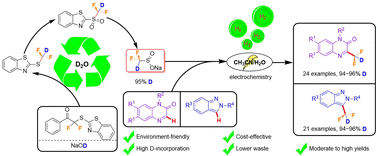
With the growing enthusiasm for the green chemistry, the efficient and convenient introduction of the deuterodifluoromethyl group (-CF2D) into drug molecules has become a research hotspot of great interest. Herein, a green and efficient electrochemical method for C(sp2)-H deuterodifluoromethylation of quinoxalinones and 2H-indazoles with CF2DSO2Na has been developed. This strategy proceeds in the mixture solution of acetonitrile/water at 25 o C without any transition-metal catalysts or stoichiometric oxidants. The value of this method is underscored by a wide range of substrates (45 examples), high yields (up to 84%) and high deuteration incorporations (approximately 96%). Radical trapping experiments and cyclic voltammetry experiments indicate that a radical pathway is involved during the reaction. Moreover, the deuteriation step in the synthesis of CF2DSO2Na has been achieved using a NaOD/D2O solution, which enables the reuse of D2O, reducing waste and further enhancing the commercial potential of this method.Green foundation1. This study presents an efficient electrochemical method for C(sp2)-H deuterodifluoromethylation of quinoxalinones and 2Hindazoles with CF2DSO2Na. Notably, this process does not require transition-metal catalysts or external oxidants, and proceeds in the green mixture solution of acetonitrile/water at 25 o C. 2. As a green synthetic approach, the green chemistry metrics of this reaction were quantified, yielding satisfactory results: the environmental factors (E-factor) were 3.27 and 2.68, the process mass intensities (PMI) were 4.27 and 3.68, the reaction mass efficiencies (RME) were 23.4% and 27.2%, the atom economies (AE) were 69.2% and 73.6%, and the carbon efficiencies (CE) were 66.0% and 68.4%. 3. Future research will focus on expanding the substrate scope, like other (hetero)aromatics, while also exploring suitable electrode materials to efficiently synthesize deuterodifluoromethylated compounds for potential use in pharmaceutical and materials science.

Supplementary files

Article information

Article type
Paper
Submitted
10 Nov 2025
Accepted
13 Jan 2026
First published
16 Jan 2026

Green Chem., 2026, Accepted Manuscript

Electrochemical C(sp2)-H Deuterodifluoromethylation of Quinoxalinones and 2H-Indazoles with CF2DSO2Na

Y. Ding, X. Liu, Y. Wu, M. Li and Z. Shen, Green Chem., 2026, Accepted Manuscript , DOI: 10.1039/D5GC05992E

To request permission to reproduce material from this article, please go to the Copyright Clearance Center request page.

If you are an author contributing to an RSC publication, you do not need to request permission provided correct acknowledgement is given.

If you are the author of this article, you do not need to request permission to reproduce figures and diagrams provided correct acknowledgement is given. If you want to reproduce the whole article in a third-party publication (excluding your thesis/dissertation for which permission is not required) please go to the Copyright Clearance Center request page.

Read more about how to correctly acknowledge RSC content.

Social activity

Spotlight

Advertisements