


 PLATFORM UPDATE:


Synergistic acidolysis–reduction–precipitation strategy driven by natural solvents for direct recovery of transition metals from spent batteries
 *ab
*ab
Abstract
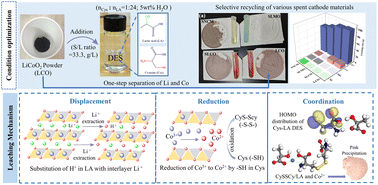
A natural deep eutectic solvent (DES), consisting of cysteine, lactic acid and 5 wt% water, is developed for the recovery of valuable metals from spent lithium-ion batteries. The DES integrates multiple functions of acidolysis, reduction and selective precipitation into one system. Under mild conditions, this DES completely dissolves LiCoO2 (LCO), achieving direct cobalt recovery and complete lithium leaching. The leaching mechanism is revealed by a combination of experimental characterization and theoretical calculations. The LA first provides protons to drive the displacement of Li+ and the dissolution of Co from the LCO. Then Co3+ is reduced to Co2+ through the dimerization of the electron-donating group (–SH) in Cys, during which Cys itself is oxidized into cystine (CySSCy). Finally, the coordinated action of LA and CySSCy immobilize Co2+ as a pink precipitate. DFT calculations further clarify the micro-scale mechanism by analyzing the transition states and energy barriers for Li/Co removal during proton attack, tracing the pathway of DES-mediated Co reduction, and comparing the binding energies and band gaps among different metal-coordination complexes. Particularly, this Cys–LA DES exhibits broad adaptability, directly recovering Co (88%), Mn (98%), and Ni/Co/Mn (nearly 99%) from spent LCO (SLCO), spent lithium manganate (SLMO), and spent ternary cathode (SNCM) via precipitation, while retaining Li in the leachate. Without hazardous reagents and complex steps, the Cys–LA DES realizes the one-step selective recovery of Li and transition metals from waste batteries. This process presents low environmental burden in the life cycle assessment covering 18 indicators, successfully balancing economic and environmental objectives.
 Please wait while we load your content...


