


 PLATFORM UPDATE:


Development and systematic evaluation of aqueous triazole chloride-based deep eutectic solvents for efficient CO2 capture

Abstract
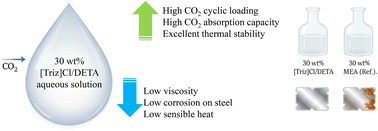
Deep eutectic solvents (DESs) have attracted considerable attention as promising alternatives to conventional solvents for mitigating CO2 emissions due to their tunable structures, low volatility, and promising physicochemical properties. In this work, a series of [Triz]Cl/amine DESs were designed and synthesized and then formulated as 30 wt% aqueous solutions (30 wt% DES + 70 wt% H2O) to systematically investigate how the type of hydrogen bond donor (HBD) affects their physicochemical properties, thermal stability, and CO2 capture performance, and to identify the most effective solvent; their CO2 absorption capacity, absorption rate, thermal stability, and desorption efficiency were determined experimentally, and a novel stepwise evaluation strategy was employed for identification. [Triz]Cl/DETA was identified, exhibiting significantly enhanced performance, with CO2 absorption capacity, absorption rate, thermal stability, and cyclic loading increased by 34%, 12%, 114%, and 39%, respectively, when compared with the conventional monoethanolamine (MEA). Its viscosity (both before and after CO2 absorption), oxidative stability, and corrosion resistance were further studied, confirming the superior performance, and the reaction mechanism was also elucidated. This work provides valuable insights into the structure–property relationships of DESs and establishes [Triz]Cl/DETA-based solvents as promising candidates for efficient and sustainable CO2 capture applications.
- This article is part of the themed collection: Green Liquids and Solvents
 Please wait while we load your content...


