


 PLATFORM UPDATE:


Hyperchaotic current coupled direct current electrolysis for enhanced manganese metal electrodeposition
 a
Qian
Zhang
*a
and
a
Qian
Zhang
*a
and
Abstract
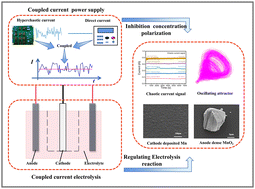
Direct current (DC) power has traditionally been used in the electrolytic manganese (Mn) industry, but its application is limited by several challenges, including thick diffusion layers, anode slime pollution, and high energy consumption. These challenges have driven efforts to explore innovative power supply strategies. In this study, we developed a hyperchaotic current coupled DC power supply for Mn electrodeposition, significantly enhancing the electrodeposition interface environment. Under the coupled current ratio of H6/D4, the current efficiency reached 86.54%, which was 4.25% higher than that of DC alone, while energy consumption decreased to 4348.19 kWh t−1, representing a 5.08% reduction. Additionally, at the H6/D4 ratio, the lead content in anode slime and Mn decreased by 53.78% and 8.3%, making it a solution that balances both economic viability and sustainability. This coupled current power system offers a clean and more energy-efficient approach that facilitates Mn production and advances new electrodeposition technologies.
 Please wait while we load your content...


