


 PLATFORM UPDATE:


Electrochemical nitrogen oxide formation from ammonia and dinitrogen

Abstract
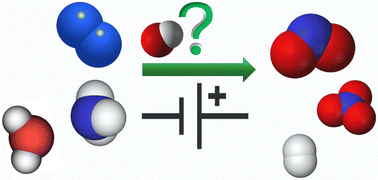
Synthetic fertilizers are required to sustain the increasing human population. Out of the many different types of fertilizers, ammonium nitrate is the most widely used type. Currently, both nitrate and ammonia are produced via energy-intensive processes, requiring high temperatures and pressures. Therefore, to make the production of the necessary fertilizers more sustainable, alternative production methods are required. One of those potential routes is electrochemical synthesis. While the electrochemical reduction of dinitrogen to ammonia has been investigated thoroughly, the synthesis of nitrate has not received as much attention. In this review, we review two different routes for the electrochemical synthesis of nitrate, starting from either molecular nitrogen or ammonia. We show that the reaction conditions can significantly alter the selectivity of ammonia oxidation. Consequently, this means that a catalyst currently tailored for oxidising ammonia to dinitrogen could potentially be used for ammonia oxidation to nitrate. Meanwhile, the direct electrochemical oxidation of molecular nitrogen suffers from false positives due to contaminations, similar to electrochemical nitrogen reduction. The current published results still lack proper control experiments, making the outcomes for now unreliable. In conclusion, for dinitrogen oxidation research, we suggest rigorous testing procedures to exclude false positive results.
- This article is part of the themed collection: 2026 Green Chemistry Reviews
 Please wait while we load your content...


