A green chemistry approach to the synthesis of an emerging drug for the treatment of celiac disease

Abstract

A sustainable synthesis of ZED1227, a new drug for treating celiac disease, is reported. The route avoids waste-generating processes resulting in an overall E-factor that reflects reliance on technologies that exist in the green chemistry toolbox, including (1) nitro group reduction using carbonyl iron powder (CIP); (2) amide coupling using 2,2′-dipyridyldithiocarbamate (DPDTC) in recoverable EtOAc; (3) olefin metathesis run under neat conditions; and (4) N-Boc deprotection in isopropyl alcohol (IPA).
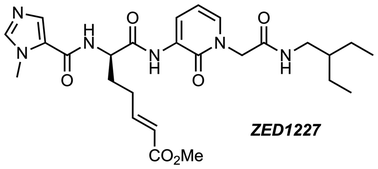
Graphical abstract: A green chemistry approach to the synthesis of an emerging drug for the treatment of celiac disease

Supplementary files

Article information

Article type
Paper
Submitted
04 Oct 2025
Accepted
21 Nov 2025
First published
02 Dec 2025

Green Chem., 2026, Advance Article

A green chemistry approach to the synthesis of an emerging drug for the treatment of celiac disease

C. B. Nelson, J. R. Yirak, M. E. Baumann, K. M. Freiberg and B. H. Lipshutz, Green Chem., 2026, Advance Article , DOI: 10.1039/D5GC05246G

To request permission to reproduce material from this article, please go to the Copyright Clearance Center request page.

If you are an author contributing to an RSC publication, you do not need to request permission provided correct acknowledgement is given.

If you are the author of this article, you do not need to request permission to reproduce figures and diagrams provided correct acknowledgement is given. If you want to reproduce the whole article in a third-party publication (excluding your thesis/dissertation for which permission is not required) please go to the Copyright Clearance Center request page.

Read more about how to correctly acknowledge RSC content.

Social activity

Spotlight

Advertisements