


 PLATFORM UPDATE:

Cascade synthesis of diarylamines catalyzed by oxygen-rich and porous carbon
 *a
Valtteri
Oksanen,
b
Sami
Heikkinen,
a
Risto
Koivula,
a
Tom
Wirtanen,
b
Michele
Melchionna,
c
Tao
Hu
d
and
Juho
Helaja
*a
*a
Valtteri
Oksanen,
b
Sami
Heikkinen,
a
Risto
Koivula,
a
Tom
Wirtanen,
b
Michele
Melchionna,
c
Tao
Hu
d
and
Juho
Helaja
*a
Abstract
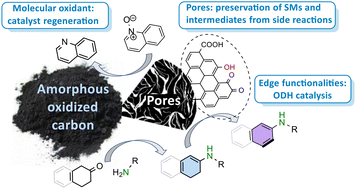
Activated carbon derived porous materials, effectively enriched with OH and C![[double bond, length as m-dash]](https://www.rsc.org/images/entities/char_e001.gif) O groups, were found to mediate, in a cascade manner, the condensation between anilines and 3-hexenones or β-tetralones, followed by their aromatization to diarylamines. The reaction proceeds via in situ formation of enamine intermediates which are subsequently oxidatively dehydrogenated in presence of a molecular oxidant under inert atmosphere. The functional groups on the carbon surface contributed actively to the catalysis: phenolic hydroxyl groups were found to promote the coupling of amines and ketones to imines and their tautomerization to enamines, while the CO groups of the quinoidic moieties catalyze the dehydrogenative aromatization step. The carbon material's extensive porous structure turns out to be critical to preserve the reactive β,γ-unsaturated cyclohexanone derivatives and their enamine intermediates from undesirable coupling and condensation side-reactions. The carbocatalyst can be regenerated by molecular N-oxo quinoline, which acts as a more convenient and cleaner stoichiometric oxidant in comparison with standard aerobic conditions (oxygen-rich atmosphere). The developed methodology delivered up to 93% yields for many diarylamines, formerly accessible exclusively via Pd-mediated couplings. Computational DFT study of possible enamine reaction modes with quinone model compounds, combined with kinetic isotope effects (KIE) suggest that the aromatization reaction is triggered by hydride abstraction at the benzylic position of the enamine intermediate.
O groups, were found to mediate, in a cascade manner, the condensation between anilines and 3-hexenones or β-tetralones, followed by their aromatization to diarylamines. The reaction proceeds via in situ formation of enamine intermediates which are subsequently oxidatively dehydrogenated in presence of a molecular oxidant under inert atmosphere. The functional groups on the carbon surface contributed actively to the catalysis: phenolic hydroxyl groups were found to promote the coupling of amines and ketones to imines and their tautomerization to enamines, while the CO groups of the quinoidic moieties catalyze the dehydrogenative aromatization step. The carbon material's extensive porous structure turns out to be critical to preserve the reactive β,γ-unsaturated cyclohexanone derivatives and their enamine intermediates from undesirable coupling and condensation side-reactions. The carbocatalyst can be regenerated by molecular N-oxo quinoline, which acts as a more convenient and cleaner stoichiometric oxidant in comparison with standard aerobic conditions (oxygen-rich atmosphere). The developed methodology delivered up to 93% yields for many diarylamines, formerly accessible exclusively via Pd-mediated couplings. Computational DFT study of possible enamine reaction modes with quinone model compounds, combined with kinetic isotope effects (KIE) suggest that the aromatization reaction is triggered by hydride abstraction at the benzylic position of the enamine intermediate.
 Please wait while we load your content...


