


 PLATFORM UPDATE:


Amorphous/crystalline heterogeneous interface synergizing with in situ-generated dual Cl−-repelling layers to realize ultrastable seawater oxidation
 *a
*a
Abstract
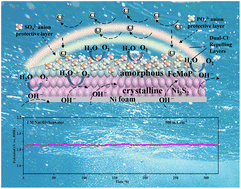
The reasonable construction of an electrocatalyst with strong corrosion resistance and high catalytic activity for the oxygen evolution reaction (OER) using earth abundant elements is of great significance to realize seawater splitting and hydrogen energy development. In this work, an amorphous/crystalline phase (a–c) heterogeneous interface (FeMoP/Ni3S2) is designed, synergizing with in situ dynamically restructured dual Cl−-repelling layers to achieve long-term and ultrastable operation in seawater oxidation. The dual Cl−-repelling layers (PO43−/SO42−) effectively repel Cl− through electrostatic attraction and reduce the adsorption energy of Cl− on the interface, further promoting preeminent corrosion resistance under harsh marine conditions. The built-in electric field formed at the a–c interface modulates the electronic structure and reduces the energy barrier required for the rate-determining step (*O → *OOH), which significantly accelerates the 4e− OER kinetics, endowing it with excellent electrocatalytic OER performance. Benefiting from this ingenious design, FeMoP/Ni3S2 needs only a low overpotential of 308 mV to reach a current density of 100 mA cm−2, achieving excellent long-term durability for 300 hours at 500 mA cm−2 in alkaline seawater. Thus, a promising strategy is provided for developing high-efficiency and corrosion-resistant seawater electrocatalysts, contributing immensely to the future development of hydrogen energy production.
 Please wait while we load your content...


