


 PLATFORM UPDATE:


Enhancing circularity of polyolefins via gasification: techno-economic and environmental evaluation of variant processes

Abstract
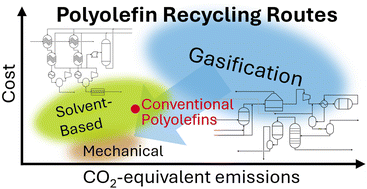
Gasification is often promoted as a primary means of converting plastic waste into a valuable product, advancing the goals of waste reduction and resource conservation. However, the most common form of chemical upcycling – converting plastic waste into other chemicals – results in the continued production of plastics from fossil fuels and requires more energy than conventional methods of disposal. This work models a fully circular system in which plastic waste is gasified to syngas and reconstituted into polyolefins via methanol and olefin synthesis, allowing gasification to be rigorously compared with other polymer recycling technologies. The model is designed to test a range of waste feeds and process conditions with the aim of minimizing cost and carbon footprint while maximizing the circularity. It is found that gasification alone has worse performance in terms of minimum selling price (MSP of $1.85 per kg product) and carbon footprint (CFP of 1.79 kg CO2-equivalent per kg waste) than mechanical and solvent-based recycling methods, and even conventional polyolefin production from fossil fuels followed by disposal via incineration with energy recovery ($1.50 per kg product, 1.33 kg CO2-eq. per kg waste). This is primarily due to the high energy demand of gasification and syngas reforming, the need for additional process inputs such as pure O2, and the relatively low product yield. To address these challenges, novel process modifications are proposed and evaluated to improve both the economic and environmental performance of the gasification process. It is found that integrating gasification with mechanical recycling process results in an overall increase in circularity with an acceptable cost ($0.87 per kg product) and carbon footprint (1.25 kg CO2-eq. per kg waste). This indicates that future gasification systems should be designed to target highly mixed and contaminated, secondary plastic waste streams that would normally be rejected by other methods.
 Please wait while we load your content...


