


Eliminating low-crystalline defects in spent graphite anodes via low-temperature molten salt activation and controlled oxidation
 *bce
and
Xuanpeng
Wang
*acde
*bce
and
Xuanpeng
Wang
*acde
Abstract
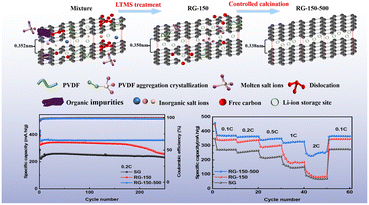
Spent lithium-ion battery graphite anodes (SG) feature in situ low-crystalline surface defects that hinder Li-ion diffusion and undermine structural stability. Conventional high-temperature remediation partially repairs defects but faces practical limitations due to energy-intensive processing and structural degradation risks. Here, we propose an efficient regeneration strategy based on low-temperature molten salt activation combined with controlled oxidation, aiming to efficiently regenerate SG with a focus on eliminating low-crystalline defects. The molten salt treatment activates the ion storage site, and the liquid-phase environment provides rapid ionic transport kinetics, facilitating impurity removal reactions. The oxidation calcination further removes low-crystalline defects of SG, ultimately harvesting regenerated graphite (RG-150–500) with purity of 99.22%. The RG-150–500 exhibits a high reversible capacity of 356.7 mAh g−1 at 0.2C, and a stable cyclability of 250 cycles with a capacity retention of 360.8 mAh g−1. From 0.1C to 2C, the rate capacity of RG-150–500 decreases from 369.5 to 243.9 mAh g−1, and when the rate returns to 0.1C, the recovery rate is 99.2%, revealing the high-rate capability of RG-150–500. Furthermore, the regeneration cost of RG-150–500 is only $7.442 per kg and the corresponding profit is $2.558 per kg. Therefore, this study provides an eco-friendly and energy-efficient solution for SG regeneration, particularly through its effective elimination of low-crystalline defects.
 Please wait while we load your content...


