


 PLATFORM UPDATE:


Episomal plasmid engineering and pathway optimization for efficient 1,8-cineole production in Yarrowia lipolytica
 *a
*a
Abstract
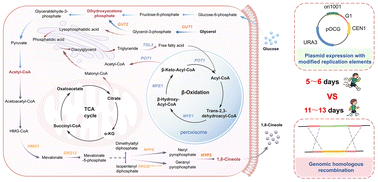
1,8-Cineole, a monoterpenoid with antibacterial, anticancer, and neuroprotective properties, is critical for pharmaceuticals but hindered by unsustainable plant extraction and chemical synthesis. We developed a robust Yarrowia lipolytica platform for 1,8-cineole biosynthesis, employing a CEN1 variant-based episomal plasmid system that served as a powerful tool for rapid and effective screening of candidate genes. Its versatility and stability facilitated efficient optimization of genetic strategies, outperforming genomic integration. Through this platform, systematic engineering of the mevalonate pathway, reinforcement of glycerol utilization and lipid degradation, and molecular docking-guided semi-rational engineering of 1,8-cineole synthase HYP3 were achieved, leading to a significant improvement in 1,8-cineole production. Integrating all the optimized strategies through CEN1 variant-based episomal plasmid system screening, we constructed strain YL2CI, achieving 755.39 mg L−1 1,8-cineole in a 5 L bioreactor. This developed platform offers a versatile genetic toolbox for efficient validation and microbial synthesis for monoterpenoid biosynthesis.
 Please wait while we load your content...


