


 PLATFORM UPDATE:


Conventional vs. direct vs. electrochemical lithium extraction: a holistic TEA–LCA of lithium carbonate production from spodumene

Abstract
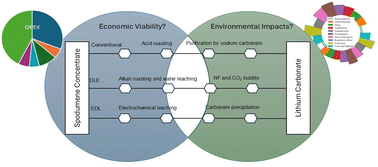
Meeting surging lithium-carbonate demand requires routes that are efficient, low-impact, and economically viable. We compare the conventional sulfuric-acid process from β-spodumene with a patented direct lithium extraction (DLE) process from α-spodumene based on low-temperature NaOH roasting, room-temperature water leaching, and CO2 precipitation, and a newly developed electrochemical direct leaching (EDL) method, which bypasses thermal conversion by operating at room temperature in dilute acid under applied potential. A cradle-to-gate life cycle and technoeconomic analysis shows that DLE reduces global warming potential by 59% (2.76 × 10³vs. 6.72 × 10³ kg CO2-eq) and lowers acidification and smog through reduced heat demand (325 °C vs. 1100 °C) and elimination of sulfuric acid. EDL shows further reductions in fossil fuel depletion, global warming, and respiratory effects. Economically, at 1 t per day, DLE delivers 41% ROROI and $18.9M NPV, outperforming the conventional route (35% and $16.0M), while EDL remains profitable (24% ROROI; $12.5M NPV) though burdened by higher CAPEX. Annual OPEX is lowest for DLE ($1.6M vs. $1.9M conventional; $2.0M EDL). Monte Carlo simulations confirm DLE's superior profitability (+$652k per year mean profit vs. −$120k per year conventional) at a small-scale process, while EDL provides intermediate returns (+$416k per year) and the lowest downside risk. Together, these results show that integrated TEA–LCA assessments capture trade-offs among emerging processes and support responsible innovation toward greener, more resilient critical-mineral extraction.
 Please wait while we load your content...


