


 PLATFORM UPDATE:


In situ growth of indium-doped cerium oxide for highly selective urea electrosynthesis from nitrate and carbon dioxide
 *a
*a
Abstract
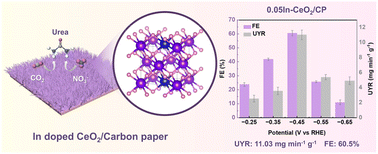
Urea electrosynthesis from nitrate and carbon dioxide offers a sustainable alternative to the traditional energy-intensive Bosch–Meiser process for urea production. This process enables the decentralized production using renewable electricity while mitigating two environmental pollutants. However, the efficiency of this process is severely limited by low selectivity and competition from side reactions. Herein, a rationally designed electrocatalyst, indium-doped cerium oxide, is in situ synthesized on carbon paper (In–CeO2/CP), for highly selective urea synthesis. The catalyst exhibits an extremely fine nanowire morphology, which is conducive to providing a larger surface area. Notably, the introduction of In generates abundant defects that can not only act as extra reactive sites, but also modulate the electronic structure to optimize the binding energies of reaction intermediates. Experimental investigations indicate that the incorporation of In effectively enhances C–N coupling and suppresses the hydrogen evolution reaction. The optimized catalyst (0.05In–CeO2) achieves a urea yield rate of 11.03 mg min−1 g−1 and a faradaic efficiency of 60.53% at −0.45 V vs. RHE, significantly outperforming undoped CeO2. Mechanistic studies suggest that CO2 directly participates in C–N coupling with nitrogenous intermediates. This work demonstrates the potential of synergistic catalyst design for efficient and sustainable electrochemical urea synthesis from waste sources.
 Please wait while we load your content...


