


 PLATFORM UPDATE:


Graphene shields enabling oxygen-durable graphite anode in high-energy lithium-ion batteries

Abstract
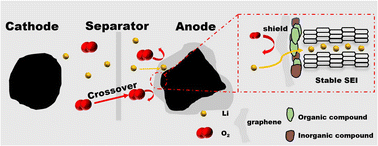
Oxygen crossover from high-voltage cathodes represents a critical challenge in developing high-energy-density lithium-ion batteries, as it induces parasitic reactions at graphite anodes and destabilizes the solid-electrolyte interphase (SEI). Here, we address this critical issue by engineering a graphene shield on graphite anodes that blocks oxygen permeation and forces oxygen gas egress during formation cycles, as verified by differential electrochemical mass spectrometry (DEMS). Cryogenic transmission electron microscopy (cryo-TEM) and atomic force microscopy (AFM) reveal the graphene-shields promote inorganic-rich SEI formation with enhanced chemical and mechanical robustness (Young's modulus: 17.63 GPa vs. 6.69 GPa baseline). Electrochemical evaluations demonstrate the shielded anode achieves improved initial coulombic efficiency, reduced irreversible capacity loss, and enhanced capacity retention during cycling of 4.8 V full cells. Impressively, in the full cells this oxygen shielding approach achieves 1.6 times higher capacity retention after 100 cycles at 4.8 V, outperforming the pristine Gr anodes. Prospectively, this approach, with synergistic integration with cathode stabilization and electrolyte engineering, may establish a viable pathway toward the commercialization of high-performance lithium-ion batteries, achieving unprecedented energy densities beyond 400 Wh kg−1 while simultaneously ensuring significantly prolonged cycle life durability through systematic interfacial engineering optimizations.
 Please wait while we load your content...


