


 PLATFORM UPDATE:


Mimicking a solvent interface at the substrate access channel of nylonase accelerates nylon degradation

Abstract
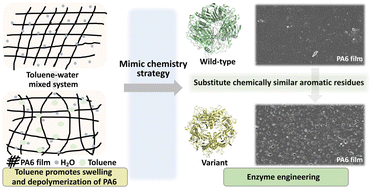
The depolymerization of plastics (e.g., PET and nylon) is of great significance to the polymer circular economy. Organic solvents (OSs) often play an important role in plastic recycling by swelling and dissolving polymers. In this study, we mimicked the swelling effect of OSs by redesigning the substrate access channel of nylonase to accelerate the depolymerization of nylon. In detail, eight OSs were evaluated and toluene showed the best swelling effect on nylon 6 (PA6). The key residues in the substrate access channel (loop88–93, loop219–222, and loop300–305) of nylonase were selected and substituted with aromatic amino acids. Multiplex PCR was used for smart library generation. After screening and rescreening, the final variant NylC-V3 (A91W/P220W/D304Y) with improved specific activity (18.7-fold) and thermostability (Tm value: increased by 3.9 °C) was obtained compared to the wild type (WT). Molecular dynamics simulations provided a mechanistic explanation for the enhanced performance of the NylC-V3 variant. The strategic incorporation of aromatic residues strengthened the interactions between adjacent subunits, increasing the structural rigidity of the enzyme. The D304Y substitution induced a steric rearrangement that widened the substrate access channel, thereby facilitating deeper substrate binding. Concurrently, the A91W substitution functioned as a molecular clasp utilizing hydrophobic forces and cation–π interactions from its indole ring to securely lock the substrate in a catalytically optimal conformation. This study provides proof of principle that mimicking the functional groups of OSs in nylon degrading enzymes accelerates depolymerization, providing a biocatalytic solution for developing environmentally friendly plastic recycling technology.
 Please wait while we load your content...


