


 PLATFORM UPDATE:


The catalytic conversion of fructose to difructose anhydride

Abstract
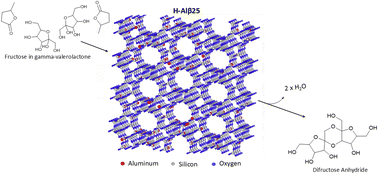
Difructose anhydride (DFA) is a highly valuable compound, traditionally obtained from inulin or sucrose through enzymatic routes. This work reports a novel eco-efficient process for DFA production from abundantly available fructose in a biomass-derived solvent over a commercial Brønsted acidic beta zeolite. A systematic evaluation of the reaction conditions led to the observation that gamma-valerolactone (GVL) is the most selective solvent giving a DFA yield of 75% under mild reaction conditions. The addition of water as a co-solvent (to improve fructose solubility) suppresses the catalytic activity. Reagent and solvent partitioning was investigated using ssNMR, utilizing the residual dipolar couplings of adsorbed species in the zeolite pores in contrast to the bulk environment. By utilizing a cross-polarization pulse sequence to observe these absorbed species and a direct polarization to observe all species in the sample, we obtained the ratio of the absorbed species to overall species in each sample at varying water content in the reaction mixture. Using this approach, we observed that at the ≥10 volume% water content mark, fructose is no longer able to enter the zeolite pores, coinciding with reaction conditions where DFA is no longer produced. The results of this study illustrate the importance of substrate and solvent partitioning on liquid phase reactions over microporous catalysts.
 Please wait while we load your content...


