


 PLATFORM UPDATE:


Light-driven and green Ullmann homocoupling with a Pd single-atom catalyst
 a
Elisa
Borfecchia,
cd
Lorenzo
Mino,
cd
Martin
Sterrer,
e
Giovanni
Di Liberto
f
and
Gianvito
Vilé
*a
a
Elisa
Borfecchia,
cd
Lorenzo
Mino,
cd
Martin
Sterrer,
e
Giovanni
Di Liberto
f
and
Gianvito
Vilé
*a
Abstract
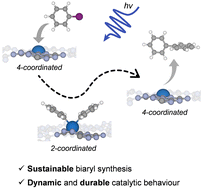
The sustainable synthesis of biaryl skeletons via Ullmann-type C–C coupling remains a challenge in organic synthesis. Herein, we report a series of Pd single-atom catalysts supported on mesoporous graphitic carbon nitride (CNx) that promote the visible-light-driven homocoupling of aryl halides under ambient reaction conditions and with high efficiency and recyclability. Spectroscopic and microscopic analyses confirmed the atomic dispersion of Pd within CNx and elucidated its local coordination environment, while demonstrating that the structural framework of the support remained intact upon metal incorporation. Mechanistic studies combining operando X-ray absorption spectroscopy and density functional theory revealed a reversible, light-induced change in Pd coordination, that is linked to the catalytic turnover. Finally, techno-economic analysis and life cycle assessment validated the sustainability of the protocol, highlighting its reduced environmental footprint compared to conventional approaches. Collectively, these findings demonstrate that photoactive single-atom catalysts are a promising platform for efficient, stable, and sustainable biaryl synthesis, paving the way for more sustainable and efficient C–C coupling methodologies.
- This article is part of the themed collection: Green Chemistry Emerging Investigators Series
 Please wait while we load your content...


