


 PLATFORM UPDATE:

Metal-free stereoselective C(sp3)–H indolation of N-heterocycles to potent antimicrobial non-canonical tryp–pro hybrids
 a
Soumya Ranjan
Bag,
a
Abdul
Akhir,
b
Deepanshi
Saxena,
b
Rahul
Maitra,
b
Sidharth
Chopra
*bc
and
Chandan K.
Jana
*a
a
Soumya Ranjan
Bag,
a
Abdul
Akhir,
b
Deepanshi
Saxena,
b
Rahul
Maitra,
b
Sidharth
Chopra
*bc
and
Chandan K.
Jana
*a
Abstract
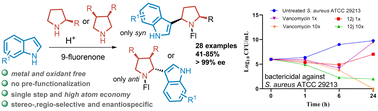
Indolyl aliphatic N-heterocycles are widely present as key structural units in many natural products and unnatural bioactive molecules. The known synthetic methods for indolyl N-heterocycles rely on metallic reagents/catalysts, hazardous oxidants, and a multistep process, often generating toxic byproducts. Herein, an unprecedented example of a metal- and oxidant-free stereoselective C(sp3)–H indolation of aliphatic N-heterocycles is reported. The C–H indolation reaction, which relies on a three-component condensation reaction, proceeds under operationally simple conditions and avoids the use of metallic reagents, oxidants, and pre-functionalization/functional group protection steps. The indolation was highly stereoselective, providing a single isomer of the six possible isomeric indolyl N-heterocycles with excellent enantiopurity (>99% ee). Interestingly, synthesized non-canonical tryptophan–proline hybrids constitute a new class of potent antibacterial agents that specifically target Gram-positive bacteria, including multidrug-resistant clinical isolates. These compounds are relatively non-toxic (SI > 20) to normal cells, have a low MIC (2 µg mL−1), and exhibit a very low propensity to induce resistance.
 Please wait while we load your content...


