


 PLATFORM UPDATE:


Uniting 3D printing and photo-thermal catalysis to achieve CO2 hydrogenation over cordierite monolithic catalysts

Abstract
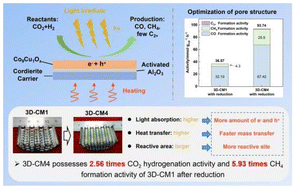
CO2 hydrogenation is a highly important reaction, as it reduces the CO2 concentration in the air and provides important chemicals. Among the CO2 conversion routes, photo-thermal catalytic CO2 hydrogenation represents a promising technology. However, the design and fabrication of efficient catalysts are significantly crucial, especially catalysts with high mass transfer and heating efficiencies. Combining the advantages of 3D printing and photo-thermal catalysis, a customized cordierite monolithic catalyst was successfully prepared in this study, which can achieve a high CO2 hydrogenation activity at a low temperature. The internal relations among macrostructure, light absorption/heat transfer, and catalytic performance were revealed in detail. The results showed that the reduction treatment of the monolithic catalyst could improve the catalytic performance obviously. This phenomenon was mainly attributed to the changes in the valence states of Co and Cu, and an increase in the number of oxygen vacancies in the catalytic coating. By suitably decreasing the transverse and longitudinal pore sizes, the catalytic performance of the monolithic catalyst was effectively improved. The main products are CO and CH4, and their highest activities reached 67.42 and 25.5 mmol g−1 h−1, respectively, at 200 °C with a H2/CO2 volume ratio of 4/1. The high catalytic performance was derived from the improvement of light absorption, heat transfer and reactive area, which collectively promoted the electron–hole pairs generated on the catalyst surface and accelerated the adsorption and diffusion of reactants on the catalyst surface.
 Please wait while we load your content...


