


 PLATFORM UPDATE:


CarAT: carbon atom tracing across industrial chemical value chains via chemistry language models
 a
David
Walz,
b
Laura Marie
Helleckes,
a
Klaus
Hellgardt
c
and
Antonio
del Rio Chanona
*a
a
David
Walz,
b
Laura Marie
Helleckes,
a
Klaus
Hellgardt
c
and
Antonio
del Rio Chanona
*a
Abstract
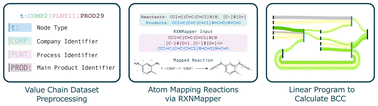
The chemical industry is increasingly prioritizing sustainability, with a focus on reducing its carbon footprint to achieve net zero. By 2026, the Together for Sustainability consortium will require reporting the biogenic carbon content (BCC) in chemical products, posing a challenge as the BCC depends on feedstocks, value chain configuration, and process-specific variables. While carbon-14 isotope analysis can measure the BCC, it is impractical for continuous industrial monitoring. This work presents CarAT (Carbon Atom Tracker), an automated methodology for calculating the BCC across industrial value chains, enabling iterative and accurate sustainability reporting. The approach leverages existing Enterprise Resource Planning data in three stages: preparing value chain data, performing atom mapping in chemical reactions using chemistry language models, and applying a linear program to calculate the BCC given known inlet compositions. The methodology is validated on a 27-node industrial toluene diisocyanate value chain. Three scenarios are analyzed: a base case with all fossil feedstocks, a case incorporating a renewable feedstock, and a butanediol value chain with a recycle stream. The results are visualized using Sankey diagrams, showing the flow of carbon attributes across the value chain. The key contribution is a scalable, automated framework for BCC calculation that can update as industrial conditions change. CarAT enables chemical manufacturers to comply with upcoming sustainability mandates while supporting carbon neutrality goals by facilitating the systematic substitution of fossil carbon with biogenic alternatives. By providing transparent, auditable tracking of carbon sources throughout production networks, this framework empowers the broader chemical industry to make data-driven decisions for achieving net-zero targets and accelerating the transition to sustainable manufacturing.
- This article is part of the themed collection: 2026 Green Chemistry Hot Articles
 Please wait while we load your content...


