


 PLATFORM UPDATE:


Following forest cues for the harvest optimization of tomorrow's biofeedstocks
 †a
Alison J.
Shapiro,
†b
Sunitha
Sadula,
*c
Dionisios G.
Vlachos,
*bc
Delphis F.
Levia
*afg
and
Thomas H.
Epps, III
*bh
†a
Alison J.
Shapiro,
†b
Sunitha
Sadula,
*c
Dionisios G.
Vlachos,
*bc
Delphis F.
Levia
*afg
and
Thomas H.
Epps, III
*bh
Abstract
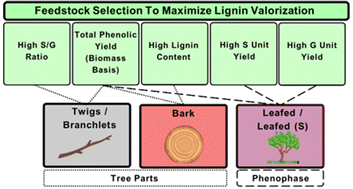
Renewable feedstocks are a critical component of sustainability and resource security efforts, and feedstock selection is vital for the improved biorefinery production of fuels, chemicals, and materials. A major hurdle for feedstock selection is the inherent heterogeneity and variability among biofeedstocks. Herein, based on knowledge convergence among tree physiological ecology, wood science, and chemical engineering, we present a harvest optimization strategy to maximize lignin valorization in carbon-neutral forestry residues, elucidating the influence of canopy phenophase on possible valorization avenues. This study provides the first report on how tree part, species, and phenophase impact lignin content and deconstruction yields and distributions. Notably, harvesting during the leafed phenophase can double or triple phenolic yields compared to other times of year, offering a simple yet effective strategy to enhance lignin valorization and overall biorefinery production.
- This article is part of the themed collection: 2026 Green Chemistry Hot Articles
 Please wait while we load your content...


