


Green and sustainable dearomative cycloaddition of arenes via visible-light energy transfer catalysis: an atom-economical synthesis of N-heterocyclic skeletons

Abstract
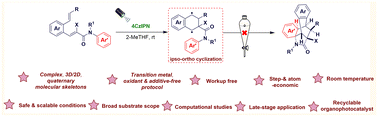
The dearomative cycloaddition of non-activated arenes is a powerful strategy for constructing the core structures of biological leads. This process requires losing aromaticity, which remains a challenge due to the inherent stability of arene (benzene) derivatives, therefore limiting their synthetic potential. Herein, we report the development of a green and sustainable dearomative cycloaddition protocol for non-activated arenes enabled by visible-light energy-transfer catalysis under metal-free photocatalytic conditions. The reaction proceeds without expensive metal photocatalysts, oxidants, or additives, delivering complex N-heterocycles in the green solvent 2-methyltetrahydrofuran (2-MeTHF). This method allows the efficient synthesis of fused tricyclic compounds exhibiting multiple quaternary carbon centers from readily accessible precursors at room temperature. Furthermore, the reaction avoids tedious workup, and the organophotocatalyst was reused for five cycles with >86% yield, demonstrating an efficient and environmentally friendly protocol. Moreover, the reaction tolerates diverse functional groups with good yields, enables late-stage functionalization and gram-scale synthesis under green conditions, and offers a general approach to previously underexplored arene dearomatization. Finally, additional experiments and computational studies were conducted to gain mechanistic insights, indicating that the reaction proceeds via a triplet energy transfer pathway rather than a thermal process.
 Please wait while we load your content...


