


 PLATFORM UPDATE:


Integrating catalytic fractionation and microbial funneling to produce 2-pyrone-4,6-dicarboxylic acid and ethanol
 †*ab
Emmanuel A.
Aboagye,
†c
Steven D.
Karlen,
ab
Jose M.
Perez,
abd
Timothy J.
Donohue,
abe
Daniel R.
Noguera
abd
and
Christos T.
Maravelias
cf
†*ab
Emmanuel A.
Aboagye,
†c
Steven D.
Karlen,
ab
Jose M.
Perez,
abd
Timothy J.
Donohue,
abe
Daniel R.
Noguera
abd
and
Christos T.
Maravelias
cf
Abstract
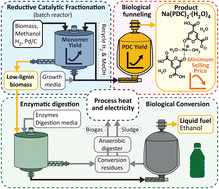
Replacing biorefinery designs that use stepwise fractionation, depolymerization, and conversion processes with designed tandem process steps can greatly reduce a biorefinery's operating costs and environmental impact. Reductive Catalytic Fractionation (RCF) is a highly efficient lignin-first approach that combines biomass fractionation and lignin depolymerization to generate a hydrogenolysis oil and pulp. The oil is composed of a complex mixture of phenolic monomers, dimers, and oligomers. Intergrating this chemical deconstruction process with microbial funneling of phenolics can simplify the product mixture and make high-value products. We applied RCF to poplar biomass in a biomass-to-bioproduct processing chain in which the phenolics were funneled to 2-pyrone-4,6-dicarboxylic acid (PDC) by an engineered strain of Novosphingobium aromaticivorans DSM12444. The pulp was enzymatically digested and the glucose and xylose was funneled to ethanol by an engineered strain of Saccharomyces cerevisiae GLBRCY945. By combining biomass fractionation and lignin depolymerization we removed a costly processing step that directly translated into a 29% reduction in the minimum selling price of PDC. This work combines experimentation with process modeling of an integrated biorefinery design to show how utilizing tandem process steps can significantly reduce operating expenses and environmental impact of upgrading lignocellulosic biomass to a portfolio of high value products.
- This article is part of the themed collection: Celebrating International Women’s day 2026: Women in green chemistry
 Please wait while we load your content...


