


 PLATFORM UPDATE:


Photocatalytic upcycling of PET into methane, hydrogen and high-value liquid products
 a
Christian M.
Pichler,
bc
Freddy
Kleitz,
d
Dominik
Eder
a
and
Alexey
Cherevan
*a
a
Christian M.
Pichler,
bc
Freddy
Kleitz,
d
Dominik
Eder
a
and
Alexey
Cherevan
*a
Abstract
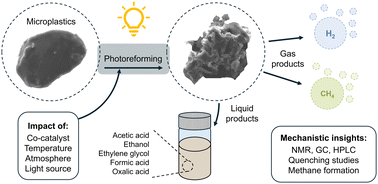
The harmful effects of daily plastic use are increasingly evident, with most waste burned or landfilled, leading to the formation of microplastics that pollute the environment and the food chain. While the full impact remains unclear, photoreforming of plastics has emerged as a promising sustainable abatement method. This study demonstrates the commercial potential of P25 TiO2 towards photocatalytic upcycling of polyethylene terephthalate (PET) microplastics by systematic exploration of the effect of co-catalysts, reaction temperature and oxygen presence on the generation of solar fuels and high-value liquid products. We demonstrate that while neat P25 yields minimal H2 evolution, increasing the reaction temperature enhances its production significantly, and the addition of Pt further boosts H2 generation by four orders of magnitude, resulting in 15.35 µmol h−1 of H2 and apparent quantum yield (AQY) values up to 0.45%. On par with H2, we observe the generation of CH4 from the reaction mixture, which we conclude to originate directly from PET rather than hydrogenation reactions. Liquid-phase analysis reveals diverse photoreforming products, including acetic acid, oxalic acid, formic acid and ethanol, with selectivity influenced by catalyst composition and reaction conditions. The feasibility of large-scale application of the process is further validated through prolonged irradiation tests using solar-simulated light and an upscaled setup, which demonstrate remarkable AQYs reaching 0.84%. These findings suggest PET photoreforming as a promising route for producing solar fuels and valuable chemicals, paving the way for sustainable plastic processing and upcycling.
- This article is part of the themed collections: Hydrogen and clean fuels and Celebrating International Women’s day 2026: Women in green chemistry
 Please wait while we load your content...


