


 PLATFORM UPDATE:


Oleic and omega-3 fatty acids buffer neuroinflammation in a scopolamine model with Alzheimer's-like features via target-level interactions
 ab
Teresa
Gonzalez-de la Rosa,
ab
Jose L.
del Rio-Vazquez,
a
Carmen M.
Claro-Cala
*bc
and
Sergio
Montserrat-de la Paz
ab
ab
Teresa
Gonzalez-de la Rosa,
ab
Jose L.
del Rio-Vazquez,
a
Carmen M.
Claro-Cala
*bc
and
Sergio
Montserrat-de la Paz
ab
Abstract
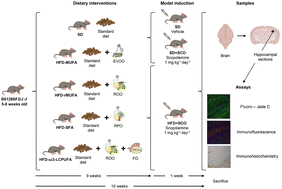
Diet quality, beyond total fat, may shape the immune tone of the brain in Alzheimer's-relevant contexts. We examined whether the fatty acid profile and food matrix of high-fat diets (HFD) modulate hippocampal neuroinflammation in vivo and explored target-level mechanisms with molecular docking. Male B6129SF2/J mice received a standard diet (SD) or HFD enriched with extra-virgin olive oil (EVOO), refined olive oil (ROO), refined palm oil (RPO), or ω3 long-chain polyunsaturated fatty acids (ω3-LCPUFA). During the final week, scopolamine induced acute cholinergic dysfunction. Neuroinflammation was assessed in the dentate gyrus by IHC (Iba-1, COX-2, and TNF-α) and by IF of astrocytes (GFAP intensity and morphology). Docking was employed to evaluate interactions of oleic and palmitic acids, EPA, and DHA with AChE, COX-2, BACE1, and TREM2. All HFD groups attenuated scopolamine-induced increases in Iba-1, COX-2 and TNF-α compared with the SD-scopolamine group, with limited separation among lipid classes under this acute stressor. By contrast, astroglial readouts showed a clear hierarchy: EVOO-HFD produced the lowest GFAP signal and the most ramified morphology, followed closely by ω3-LCPUFA, with ROO being intermediate and SFA being the least favourable. Docking supported a mechanistic framework: EPA/DHA displayed stronger predicted engagement than oleate/palmitate at COX-2 and BACE1, while long-chain fatty acids occupied the AChE peripheral site and a lipid/apoE-responsive surface on TREM2. In conclusion, PUFA-rich feeding, and notably that with the EVOO matrix, preferentially buffers hippocampal neuroinflammation in a scopolamine-induced Alzheimer's-like model. These findings support a composition, binding, and function framework and strengthen the translational rationale for precision nutrition strategies prioritizing ω3-LCPUFA and high-quality olive oils.
 Please wait while we load your content...


