


 PLATFORM UPDATE:


Association between habitual dietary taurine intake and the risk of metabolic dysfunction-associated steatotic liver disease: a prospective cohort study
 †ab
Kaijun
Niu
*def
and
†ab
Kaijun
Niu
*def
and
Abstract
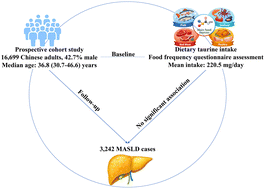
Taurine, an amino sulfonic acid abundant in seafood and meat, has been proposed to have a potential role in the prevention of metabolic dysfunction-associated steatotic liver disease (MASLD) due to its antioxidant and anti-inflammatory properties. However, the association between dietary taurine intake and MASLD remains unclear in human populations. Also, data on dietary taurine intake among adults in China are currently lacking. Here, we investigated the habitual dietary taurine intake and examined its association with the risk of incident MASLD in the Chinese general adult population. This prospective cohort study included 16 699 participants (median [interquartile range] age: 36.8 [30.7, 46.6] years; 42.7% male) free of cardiovascular disease, cancer, and liver disease at the baseline. Dietary taurine intake was assessed using a validated food frequency questionnaire. Incident MASLD cases were identified by abdominal ultrasonography. The association between dietary taurine intake and the risk of MASLD was evaluated using Cox proportional hazards regression models. The estimated daily mean taurine intake was 220.5 (standard deviation: 150.0) mg. Over 57 968 person-years of follow-up, 3242 incident MASLD cases were documented. In the fully adjusted model, compared with participants in the lowest sex-specific quartile of absolute taurine intake, the hazard ratios (95% confidence intervals) for incident MASLD were 1.01 (0.91, 1.11) for quartile 2, 1.03 (0.93, 1.14) for quartile 3, and 1.04 (0.92, 1.18) for quartile 4, respectively (P for trend = 0.50). Similar results were observed when taurine intake was adjusted for total energy intake using the residual method and nutrient density method or body weight. In addition, subgroup analyses generally yielded consistent findings. In conclusion, habitual dietary taurine intake is not significantly associated with the risk of MASLD in the general adult population, suggesting that dietary taurine intake alone may not be sufficient to prevent the onset of MASLD.
 Please wait while we load your content...


