


 PLATFORM UPDATE:


Effects of combined phytosterols and phospholipids on blood lipids and the fluidity and lipid profiles of the erythrocyte membrane in individuals with borderline hyperlipidemia: a double-blinded randomized controlled trial

Abstract
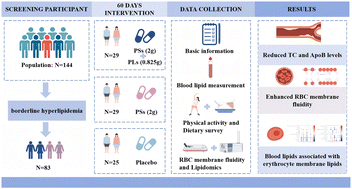
This study aimed to evaluate the effects of phytosterols (PSs) alone and in combination with phospholipids (PLs) on blood lipid levels, erythrocyte membrane fluidity (EMF) and lipid profiles in subjects with borderline hyperlipidemia in a randomized, double-blind, placebo-controlled clinical trial. Among 144 initially screened participants, 87 were enrolled and randomly assigned to three groups receiving PSs (2 g of PSs), PSs and PLs (2 g of PSs plus 0.825 g of PLs), or placebo for 60 days, respectively. A total of 83 subjects completed the entire trial. After 60 days of intervention, the levels of total cholesterol (TC) and apolipoprotein B (ApoB) in the combined PSs and PLs group decreased by 7.8% and 6.4% (P < 0.001), respectively, relative to the baseline. In the PSs-only group, the level of total cholesterol (TC) was significantly reduced by 6.2% (P < 0.001). Nevertheless, in the PSs and PLs group, low-density lipoprotein cholesterol (LDL-C) was significantly reduced by 7.7% compared with the baseline only at 30 days of intervention (P = 0.017). After 60 days of intervention, ExGP in the PSs and PLs group decreased by 0.66% compared with the baseline, but this change was not statistically significant. Results from the erythrocyte membrane lipidomic analysis indicated that TC and LDL-C were significantly negatively correlated with phosphatidylserine (PS), phosphatidylcholine (PC), and bis(monoacylglycerol)phosphate (BMP). Additionally, the excitation generalized polarization (ExGP) value was significantly negatively correlated with PC. In the future, supplementation with phytosterols and phospholipids may be considered for improving blood lipid profiles in individuals with borderline hyperlipidemia, thereby preventing or delaying the progression to overt hyperlipidemia and cardiovascular diseases.
- This article is part of the themed collection: Food & Function HOT Articles 2026
 Please wait while we load your content...


