


 PLATFORM UPDATE:


Phenylpropanoid-homoisoflavonoid derivatives from the fruits of Hippophae rhamnoides L. and their hepatoprotective and hypolipidemic activities
 a
Rong-Rui
Wei
*a
a
Rong-Rui
Wei
*a
Abstract
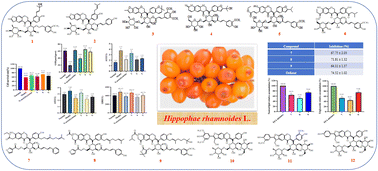
The fruit of Hippophae rhamnoides L. is not only an edible fruit, but also an important medicinal plant. Therefore, it has potential research and development value. Twelve new phenylpropanoid-homoisoflavonoid derivatives (1–12), including (9 → 1″)-rutinosyl-12-methyl-6,7-furan-phenylpropanoid-homoisoflavonoids (1–3), (9 → 1″)-(3″-O-(3‴′-methoxy-4‴′-cinnamic acid))-(6″ → 1‴)-diglucosyl-phenylpropanoid-homoisoflavonoids (4–6), (9 → 1″)-glucosyl-phenylpropanoid-homoisoflavonoids (7–9), 10-methylol-9-rutinosyl-(2″ → 1‴′)-glucosyl-phenylpropanoid-homoisoflavonoids (10–12), and eleven known phenylpropanoid-homoisoflavonoid derivatives (13–23) were isolated from the fruits of Hippophae rhamnoides L. for the first time, and their structures were identified by extensive spectroscopic data (1D and 2D NMR (Nuclear Magnetic Resonance), MS (Mass Spectrometry), IR (Infrared Spectroscopy), UV (Ultraviolet and Visible Spectroscopy), etc.), physical and chemical properties, and comparison with references. Among them, compounds (3–5) (12 μM) exhibited moderate hepatoprotective activities with survival rates of 62.40 ± 1.44%, 72.52 ± 1.16%, 65.31 ± 1.21%, respectively. Moreover, compounds (3–5) increased the GSH (Glutathione) level, and lowered ALT (Alanine Aminotransferase), AST (Aspartate Aminotransferase), LDH (Lactate Dehydrogenase) levels. Meanwhile, compounds (7–9) (120 μM) displayed moderate inhibition of pancreatic lipase activity with inhibition rates of 67.75 ± 2.03%, 71.81 ± 1.32%, 64.11 ± 1.37%, respectively. Moreover, compounds (7–9) decreased FFA-induced lipid accumulation in HepG2 liver cells, and inhibited triglyceride and intracellular neutral lipid accumulations at the concentration of 60 μM with inhibition rates of 52.93 ± 1.73% and 64.23 ± 1.87%, 44.47 ± 1.16% and 51.62 ± 1.05%, 75.08 ± 2.52% and 74.04 ± 2.39%, respectively. In addition, compounds (3–5), which mainly possessed 3′/4′-furan ring or 4′/5′-pyran ring in their structures, showed moderate hepatoprotective activities, and compounds (7–9) showed moderate hypolipidemic activities because their structures contained 7′-alkene fragment. Compounds (1–12) were classed into four different types of phenylpropanoid-homoisoflavonoid derivatives according to their structural characteristics and complex biogenetic pathways. The molecular docking simulations of compounds (3–5) with hepatoprotective activities and compounds (7–9) with hypolipidemic activities were analyzed and discussed in the work.
 Please wait while we load your content...


