


 PLATFORM UPDATE:

Goal orientation is a key determinant of healthy dietary behaviour change in European adults receiving personalised vs. non-personalised nutrition advice
 a
Brendan P.
Bunting,
b
Lynn J.
Frewer,
c
Katherine M.
Livingstone,
d
John C.
Mathers
e
and
Barbara J.
Stewart-Knox
*fg
a
Brendan P.
Bunting,
b
Lynn J.
Frewer,
c
Katherine M.
Livingstone,
d
John C.
Mathers
e
and
Barbara J.
Stewart-Knox
*fg
Abstract
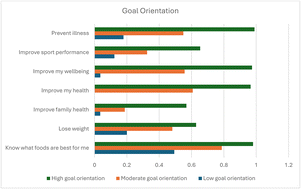
Although personalised nutrition is more effective than generic approaches to dietary health promotion, effect sizes tend to be small. Behaviour change theory implies the importance of goal setting to successful health intervention. This secondary analysis of the Food4Me personalised nutrition intervention study (N = 1480) sought to understand the role of goal orientation and habit strength in determining dietary change. Latent class analysis (LCA) identified three groups distinguished by degree of goal orientation (low; moderate; high) at baseline. Data were analysed using multigroup binary channel coding (BCH) models with auxiliary variables. Differences in healthy eating indices (HEI) between treatment (randomised to personalised nutrition advice) and control (generic dietary advice) groups at 6-months post-intervention were compared within latent classes distinguished by goal orientation. A second model included habit strength, measured by the self-report habit index (S-RHI), as an outcome and compared treatment and control groups within classes defined on goal orientation. The results indicated that HEI increased significantly in response to treatment (compared with controls) post-intervention only among those participants with high baseline goal orientation (P < 0.0001). S-RHI at baseline was associated with higher HEI at 6-months within all three classes defined on goal orientation but did not alter the initial result indicating higher HEI only in the high goal-oriented group. These findings indicate the importance of goal orientation to success of personalised nutrition and reinforce previous research linking habit strength to dietary behaviour change. Personalised interventions should include goal setting at the outset, monitor progress towards goals and encourage strong healthy eating habits.
- This article is part of the themed collection: Precision nutrition
 Please wait while we load your content...


