


 PLATFORM UPDATE:


Unifying lipolysis under intestinal INFOGEST conditions by total surface area and coalescence
 *a
Boxin
Deng
a
and
*a
Boxin
Deng
a
and
Abstract
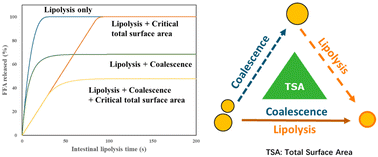
The INFOGEST in vitro digestion protocol is an important step toward quantifiable comparison of lipid digestion results. Still, interpreting results across different food emulsions remains challenging due to differences in oil content, droplet size, and emulsion stability. Because of that, we systematically investigated whey protein isolate-stabilized emulsions (d32 = 0.16 and 7.2 μm) at 0.28–56.35 mM oil concentration, and considered lipase and bile salt levels as additional factors. As expected, smaller droplets digested faster than larger ones at the same oil concentration, but differences could not be explained by available surface area alone. We found that lipolysis was governed by the interplay between oil content, droplet size, emulsion stability, and enzyme availability. We developed a lipolysis-coalescence model that incorporates a critical total surface area (CTSA), below which the whole surface area contributes to lipolysis, while this is limited to the critical total surface area when enzymes are present in surplus. Besides, a coalescence rate constant is introduced, which reduces the available surface area, in conjunction with a droplet size decrease due to digestion, and thus limiting the rate (and extent) of lipolysis in time. The model was used to compare digestive conditions with varying amounts of lipase and bile, and was able to capture essential effects. Our lipolysis-coalescence model can be used to deconvolute the effects of droplet size, initial oil concentration and coalescence on lipolysis, which is the essential step needed to arrive at a unified interpretation of lipid digestion under INFOGEST conditions.
- This article is part of the themed collection: Food & Function HOT Articles 2026
 Please wait while we load your content...


