


 PLATFORM UPDATE:


Tea and coffee intakes, COPD, adult asthma, and lung function in the UK Biobank

Abstract
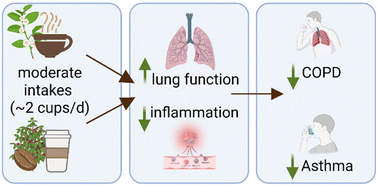
Introduction: Previous studies suggest non-linear associations between tea and coffee intake and respiratory health, with lower risks at low-to-moderate intakes but higher, unexplored risks at high intakes. This study aims to investigate associations between tea and coffee intake and the risk of chronic obstructive pulmonary disease (COPD) and adult-onset asthma. Methods: Among 366 869 participants of the UK Biobank, intakes of tea and coffee were derived from both a food frequency questionnaire and from repeated 24 hour diet assessments. Cross-sectional associations with measures of lung function [forced expiratory volume in 1 second (FEV1), forced vital capacity (FVC), and FEV1/FVC] and inflammation—represented by the INFLA score—and prospective associations with both incident COPD and adult-onset asthma were examined using multivariable-adjusted linear regression and Cox proportional hazards models, respectively. Results: Compared to not consuming tea or coffee, low intakes (0.5–2 cups per d) were associated with better lung function, lower inflammation, and a lower risk of incident COPD [HR (95% CI); tea: 0.87 (0.81, 0.93) and coffee: 0.86 (0.82, 0.92)] and asthma [coffee: 0.90 (0.85, 0.95)]. A higher risk of COPD was seen for high tea, but not coffee, intakes when analyses were restricted to never smokers, but not when participants with respiratory symptoms at baseline were excluded. Conclusion: Both tea and coffee can be part of a healthy diet when consumed in moderation (∼2 cups per d). The lack of a beneficial association at high intakes may be due to residual confounding from smoking for coffee and, in part, reverse causation for tea.
- This article is part of the themed collection: Food & Function HOT Articles 2026
 Please wait while we load your content...


