


 PLATFORM UPDATE:


Inducing nonlinear conductance and emergent memristance in open pores using blockers
 a
Stephen A.
Sarles
d
and
a
Stephen A.
Sarles
d
and
Abstract
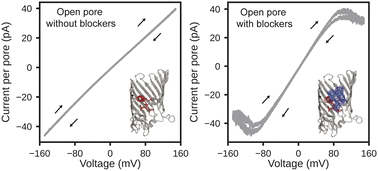
Memristance in biomembrane systems is an emerging area of research relevant to biocomputing. Work has so far focused on voltage-driven insertion of pore-forming peptides in droplet interface bilayer systems, design of asymmetric pores, and lipid membrane poration. However, only a few instances of always-open, pore-forming channels have been used to design and study the emergence of memristive behaviors in biomimetic membranes. In this work, we investigate the Outer Membrane Protein F (OmpF) as a model nanopore. Due to its nanoscale pore size (∼1 nm diameter), OmpF can be transiently or partially blocked by a variety of molecules, including antibiotics, polyamines, and polypeptides. We reconstituted OmpF into droplet interface bilayers and examined electrical signatures of different blocking agents using cyclic voltammetry. We show that binding of some of these agents to pore-lining residues induces strongly nonlinear current–voltage (I–V) responses, which, in some instances, give rise to memristive behavior. We find that the interaction of ampicillin and spermine with OmpF at the tested conditions was insufficient to produce nonlinearity or memristance. However, interaction between arginine polypeptides and OmpF leads to length and charge-dependent nonlinear conductance with emergent memristance in the case of arginine nonapeptide. Molecular dynamics simulations showed that arginine pentapeptides (Arg-5) block the pore longitudinally as a stretched chain whereas bulkier and highly charged arginine nonapeptides (Arg-9) block the pore transversally by compaction of the peptide chain. Although both blocking conformations were sufficient to exhibit nonlinear dynamics, only the transversal blocking conformation led to emergent memristance, likely due to longer-lived interactions between binding sites and the Arg-9.
- This article is part of the themed collection: Molecular and Ion Flows through Angstrom-scale Channels Faraday Discussion
 Please wait while we load your content...


